
Scientific Work, Education, and Public Memory in Nova Scotia
Canada’s scientific history includes long periods of applied research carried out outside universities and formal laboratories. In Nova Scotia, especially in Cape Breton, experimental work in communication, flight, and marine engineering developed over decades and later became part of public education and heritage interpretation. This text brings together that technical work, the social context around it, and the later efforts to preserve and explain it for the public. At the centre of this record is Alexander Graham Bell, whose work followed practical questions rather than commercial plans.
Early Work on Sound, Speech, and Hearing
Bell’s earliest experiments grew directly from his teaching work with deaf students in Boston. He studied how sound could be recorded visually and how speech related to air pressure, vibration, and the structure of the human ear. He aimed to understand speech as a physical process rather than as an abstract idea..
Main Questions Guiding Early Research
- How sound could be represented visually
- How speech related to air pressure changes
- How electrical signals could reflect sound patterns
- How hearing mechanics influenced speech production
At this stage, Alexander G. Bell was focused on physical principles, not on building a consumer device.
The Telephone: Key Moments
By the mid-1870s, Bell had formed a workable concept for transmitting speech electrically. This led to formal testing and public demonstration.
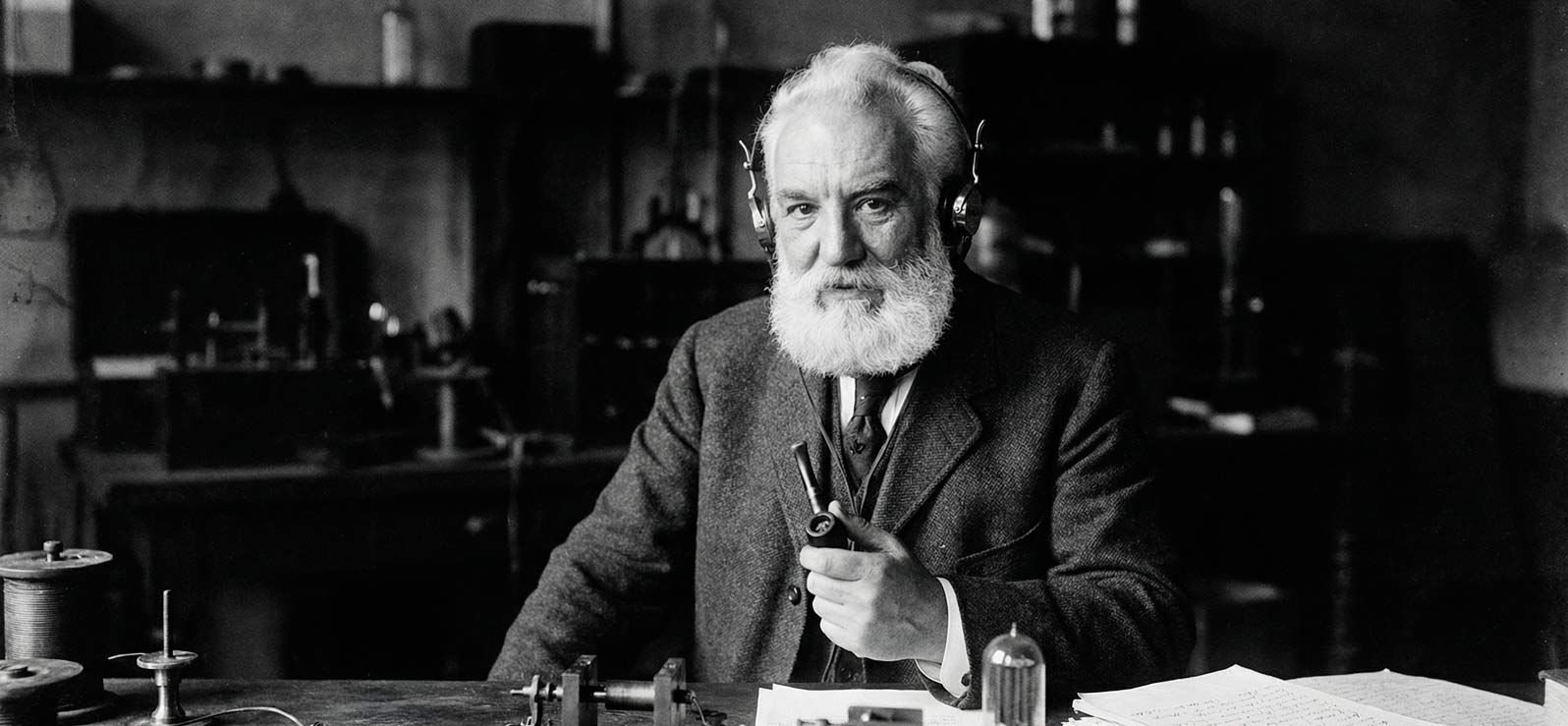
Telephone development milestones
Year | Description |
|---|---|
1874 | Core concept of electrical speech transmission formed |
1876 | Patent granted |
1876 | First complete spoken sentence transmitted |
1876 | Public demonstration using existing telegraph lines |
Despite later adoption, Graham Bell avoided keeping the device in his own study, preferring fewer interruptions while working.

Research After Patent Income
Income from the telephone patent reduced financial pressure and allowed Bell to pursue other areas of interest. His attention shifted toward long-term experimentation without immediate commercial aims. In correspondence and informal writing, his name often appears as Alex G Bell, reflecting everyday usage. These later projects expanded well beyond communication technology.
Research Based in Nova Scotia
Bell’s long-term experimental work became closely tied to Cape Breton Island. His research base was located at Beinn Bhreagh Nova Scotia, chosen for access to open water, isolation, and space for large-scale testing.
The property, known as the Beinn Bhreagh estate, served as both a residence and a working research site. Aircraft components, kites, boats, and experimental structures were built and tested there. Over time, Beinn Bhreagh came to describe not only the location but also the body of work associated with it.
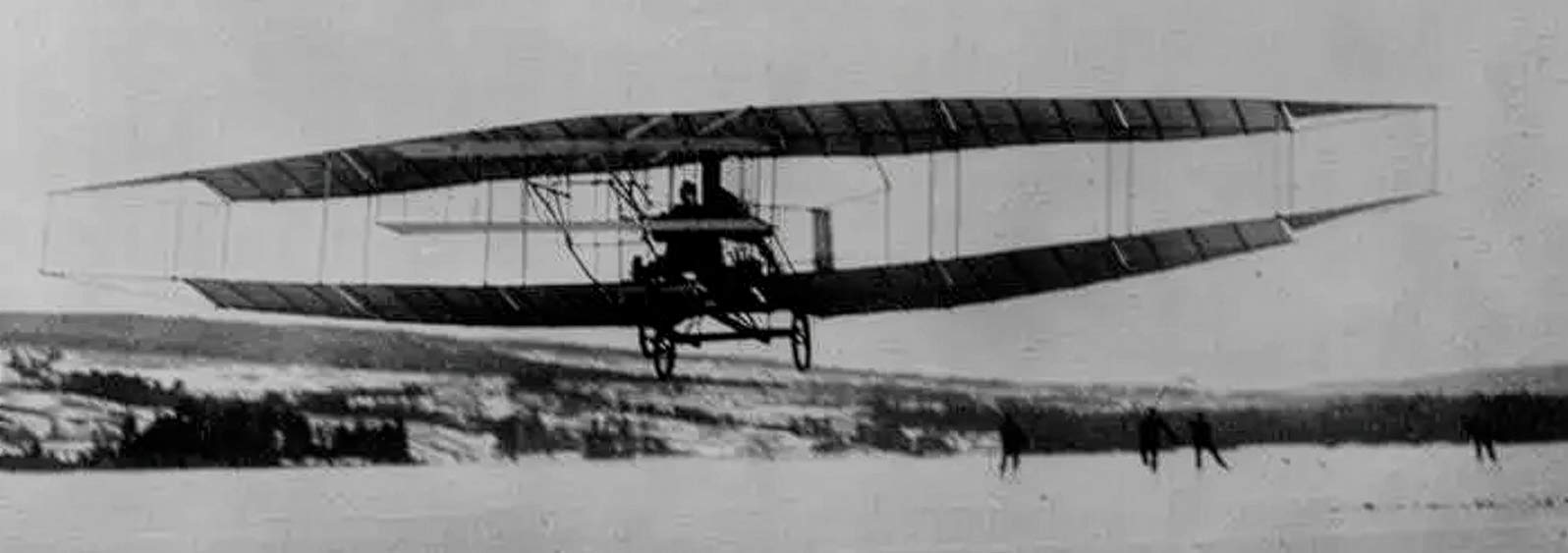
Aviation and Team-Based Work
Bell’s projects relied on collaboration. Engineers, sailors, pilots, and craftsmen worked together, with responsibilities divided by skill rather than rank. Several aircraft designs were tested during this period, including the first powered airplane flown in Canada. Contemporary accounts describe scientist Graham Bell as someone who supported and organized group work rather than directing every detail himself.
Marine Engineering and Lift Experiments
Challenges encountered during early flight testing prompted experiments with water. The goal was to reduce resistance and improve lift during movement. A hydrofoil is a submerged wing-shaped structure that lifts a vessel’s hull as speed increases. Some early documents use the spelling hydro foil, reflecting the technical language of the time. Repeated trials on Baddeck Bay resulted in experimental craft, including a record-setting hydrofoil boat tested in 1919.
Areas Covered by Experimental Work
Much of Bell’s output is grouped under Alexander Graham Bell inventions, which include work in:
- communication devices
- aviation experiments
- marine craft
- environmental and energy studies
Historical sources vary in spelling, including Alexander Grahm Bell, depending on the publication.
Mabel Hubbard Bell and Organizational Support
Bell’s research depended heavily on organizational and financial support provided by Mabel Hubbard Bell. Deaf from early childhood, she remained active in education, community life, and research organization. She managed finances, supported research teams, and helped maintain continuity during long experimental periods. Her work also extended into public libraries, women’s education, rural crafts, and local development in Baddeck and surrounding areas. This contribution explains why simplified accounts that focus only on technical work remain incomplete.
From Private Research to Public Heritage
After Bell’s death, responsibility for preserving this body of work shifted toward public organizations. Exhibitions, archives, and interpretation are now maintained at Alexander Graham Bell National Historic site in Baddeck.

The grounds include buildings linked to Alexander Graham Bell house, which served as both residence and work space. Some records list the same structure as Alexander Graham Bell home, depending on cataloging practice. Archival systems may repeat Alexander Graham Bell house to maintain consistency.
Name Variations in Historical Records
Name form | Typical context |
|---|---|
Alexander Bell | Simplified public references |
Alex graham Bell | Informal publications |
Alexander G. Bell | Technical and written correspondence |
All refer to the same individual.
The Educational Charity and Its Status
In 2016, a not-for-profit charity was registered in Canada under the Income Tax Act to support education and public understanding of the legacy connected to Bell’s work in Nova Scotia. Its focus included partnerships, community capacity building, and collaboration with heritage bodies.
Public records and archived material indicate that the organization is no longer active as an independent entity. Its former address now corresponds with the national historic site, and there is no recent evidence of ongoing operations. This pattern reflects a common lifecycle for small educational charities.
Why This Record Is Still Used
- shows long-term applied research outside formal institutions
- documents collaboration across disciplines
- links private experimentation to public education
- explains how historical work enters public record
Whether cited as Alexander G. Bell in technical writing or referred to more broadly as Alexander Graham Bell, the Nova Scotia work remains part of Canada’s documented scientific history.
Email: [email protected]
Disclaimer
This text is provided for informational purposes only. It is not affiliated with or endorsed by any museum, foundation, family, or public authority. All names, brands, and references are used strictly in a descriptive and informational context. All rights remain with their respective holders.
Previously, this website and the associated brand were operated by different owners who shaped its original direction and content structure. Since that time, the project has changed ownership and editorial approach. The current version of the site is not connected to the former owners, their decisions, or their business activities. Any mention of the brand and its history is included solely for reference and informational purposes.
Last updated: 2026